Tang dynasty

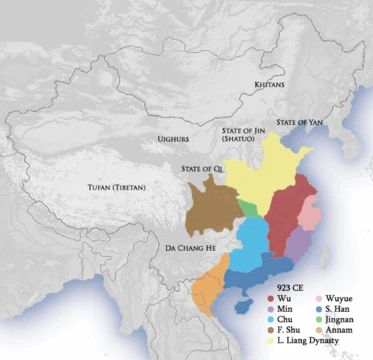
It was preceded by the Sui dynasty and followed by the Five Dynasties and Ten Kingdoms period. Historians generally regard the Tang as a high point of Chinese civilisation, and a golden age of cosmopolitan culture. Tang territory, acquired through the military campaigns of its early rulers, surpassed that of the Han dynasty.
- died
- 907 (end of dynasty)
- field
- Imperial dynasty
- nationality
- Chinese
- known_for
- Golden age of Chinese civilisation, cosmopolitan culture, poetry, woodblock printing, and territorial expansion
Lore & Background
The Li family founded the dynasty after taking advantage of a period of Sui decline and precipitating their final collapse. Emperor Gaozu (born Li Yuan) was the founder, previously Duke of Tang and governor of Taiyuan. Taizong proved a capable leader, destroying the Eastern Turkic Khaganate and being accepted as their khagan.
Reader's Guide
The Tang dynasty is significant as a high point of Chinese civilisation, marked by a golden age of cosmopolitan culture. Its territory surpassed that of the Han dynasty, and its capital Chang'an was the world's most populous city for much of its existence. The dynasty maintained a civil-service system through standardised examinations and recommendations, though regional military governors (jiedushi) later undermined this order. Chinese culture flourished, especially poetry, with famous poets Li Bai and Du Fu, and painters such as Han Gan. Innovations included woodblock printing. Buddhism became a major influence, though Emperor Wuzong suppressed it in the 840s. The An Lushan rebellion (755–763) led to decline, and agrarian rebellions, population loss, and government dysfunction ended the dynasty in 907. The Tang exerted powerful cultural influence over Japan and Korea.
Did You Know?
- The Tang capital at Chang'an was the world's most populous city for much of the dynasty's existence.
- Two of China's most famous poets, Li Bai and Du Fu, belonged to the Tang era.
- The Tang dynasty developed woodblock printing as a notable innovation.
Frequently Asked Questions
What is Tang dynasty known for?
Tang is celebrated as a golden age of Chinese civilisation, renowned for its cosmopolitan culture, poetry, woodblock printing, and sweeping territorial expansion. Its early rulers waged military campaigns that pushed the dynasty's borders well beyond those of the earlier Han dynasty.
How does Tang dynasty's story end?
The dynasty's rule concluded in 907, after which China fractured into the Five Dynasties and Ten Kingdoms period. This marked the close of roughly three centuries of Tang imperial governance over the region.
Why is Tang dynasty important?
Historians broadly regard the Tang as a high point in Chinese civilisation, representing a peak of cosmopolitan culture and artistic achievement. Its lasting legacy in poetry, printing technology, and territorial reach shaped the trajectory of subsequent Chinese history.
More in Dynasties And Kingdoms 1-19
Spotted an error? Know more?
This is a living reference — every entry is fact-audited, and reader corrections feed straight into our audit queue. Suggest an edit · See this site's audit record