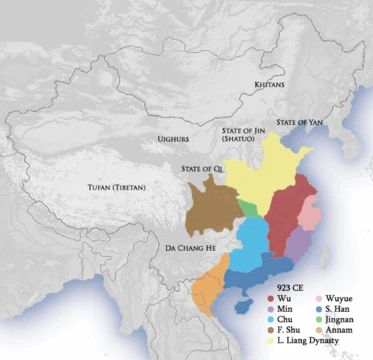
Five Dynasties and Ten Kingdoms period
An era of division and warfare in Imperial China.

The Five Dynasties and Ten Kingdoms period was an era of political upheaval and division in Imperial China from 907 to 979 CE. Five dynastic states quickly succeeded one another in the Central Plain, while more than a dozen concurrent dynastic states, of which the most powerful and influential ten were known as the ten kingdoms, were established elsewhere, mainly in South China. It was a prolonged period of multiple political divisions in Chinese imperial history.
- start
- 907 CE
- end
- 979 CE
- preceded_by
- Tang dynasty
- followed_by
- Song dynasty
- region
- Imperial China
- key_feature
- Political upheaval and division
Lore & Background
The era is traditionally seen as beginning with the fall of the Tang dynasty in 907 and reaching its climax with the founding of the Song dynasty in 960. In the following 19 years, Song gradually subdued the remaining states, culminating with the conquest of the northern state of Northern Han in 979, but the Liao dynasty still remained in China's north, and the Western Xia was eventually established in China's northwest. Many states had been de facto independent long before 907 as the late Tang dynasty's control over its numerous fanzhen officials waned, but the key event marking the start of the period was the formal end of the Tang dynasty and the establishment of the Later Liang in 907. After the Tang collapsed, several warlords of the Central Plain crowned themselves emperor. During the 70-year period, there was near-constant warfare between the emerging kingdoms and the alliances they formed. All had the ultimate goal of controlling the Central Plain and establishing themselves as the Tang's successor.
Reader's Guide
The Five Dynasties and Ten Kingdoms period represents a critical transitional phase in Chinese history, bridging the Tang and Song dynasties. The term 'Five Dynasties' was coined by Song dynasty historians and reflects the view that the successive regimes based in Kaifeng controlled the Central Plain and possessed the Mandate of Heaven. The first of the Five Dynasties was founded by Zhu Wen, the rebel defector turned warlord who ultimately ended the Tang dynasty. The rest of the Five Dynasties as well as the Song dynasty all emerged from a military organization originally led by Shatuo Turks whose commanders replaced each other in frequent coup d'état. The Southern regimes generally had more stable and effective government during this period, allowing them to embark on trade, land reclamation, and infrastructure projects, laying the groundwork for the Song Dynasty economic boom. This economic shift to the south also led to a vast southward migration. The last of the Five Dynasties and Ten Kingdoms regimes was Northern Han, which held out until Song conquered it in 979. For the next several centuries, although the Song controlled much of South China, they coexisted alongside the Liao dynasty, Jin dynasty, and various other regimes in China's north, until finally all of them were conquered by the Yuan dynasty.
Did You Know?
- The era lasted from 907 to 979 CE.
- The term 'Five Dynasties' was coined by Song dynasty historians.
- The last regime to fall was Northern Han, conquered by Song in 979.
- Southern kingdoms were more stable than the North and engaged in trade and infrastructure projects.
Frequently Asked Questions
What is the Five Dynasties and Ten Kingdoms period?
It was a turbulent stretch of Chinese history from 907 to 979 CE in which the empire broke apart into multiple rival states. In the northern Central Plain, five short-lived dynasties rose and fell in quick succession, while roughly a dozen other kingdoms — the ten most prominent being the so-called Ten Kingdoms — held territory across southern China.
What defines the Five Dynasties and Ten Kingdoms period's political structure?
The era is marked by simultaneous fragmentation, with five successive dynastic regimes controlling the northern heartland while ten major kingdoms operated independently in the south. This made it one of the longest stretches of divided rule in Chinese imperial history.
How does the Five Dynasties and Ten Kingdoms period come to an end?
The period concluded in 979 CE when the Song dynasty finished its reunification campaign by conquering the last remaining southern kingdom. That victory ended the era of multiple rival states and restored a single imperial authority over China.
Why is the Five Dynasties and Ten Kingdoms period historically significant?
It represents a prolonged interval of upheaval and warfare that shattered the centralized order inherited from the Tang dynasty. The chaos and regional autonomy of this era directly shaped the institutional reforms and military strategies of the Song dynasty that followed.
What precedes and follows the Five Dynasties and Ten Kingdoms period?
It immediately followed the collapse of the Tang dynasty and was succeeded by the reunified Song dynasty. The transition marks a shift from a single imperial power to fragmented multi-state rule and back to centralized governance.
More in Dynasties And Kingdoms 1-19
Spotted an error? Know more?
This is a living reference — every entry is fact-audited, and reader corrections feed straight into our audit queue. Suggest an edit · See this site's audit record