Liao dynasty
Khitan-led dynasty that ruled northern China and Manchuria.

Founded around the time of the Tang dynasty's collapse, it at its greatest extent ruled over Manchuria, the Mongolian Plateau, the northern part of the Korean Peninsula, southern portions of Siberia, and the northern tip of the North China Plain.
- field
- Imperial dynasty of China
- nationality
- Khitan (ruled by Yelü clan)
- known_for
- First state to control all of Manchuria; Chanyuan Treaty with Song; origin of the name 'Cathay' for China
Lore & Background
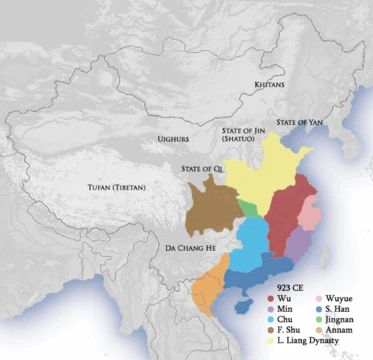
The Liao dynasty rose from the consolidation of power among the Khitans in the 8th century and their expansionist campaigns in the latter half of the 9th century. The dynasty launched multiple military campaigns against neighboring states and peoples, including the Kumo Xi, Shiwei, Tatars, Zubu, Khongirad, Balhae, Goryeo, Later Tang, and the Song dynasty. Its conquests include the Sixteen Prefectures (including present-day Beijing and part of Hebei) by fueling a proxy war that led to the collapse of the Later Tang (923–936).
Reader's Guide
The dynasty's name alternated between Great Khitan and Great Liao, reflecting shifts in identity. The term 'Khitai' became the source of the medieval European name 'Cathay' for China, and is still used by Turkic and some Slavic peoples to refer to China. Cultural achievements of the Liao include statuary and artifacts, though questions remain about their influence on later developments such as musical and theatrical arts.
Did You Know?
- The Liao dynasty was the first state to control all of Manchuria.
- The name 'Cathay' for China derives from 'Khitai', the name of the Liao dynasty's people.
Seeds of Fragmentation in the Late Tang
The collapse of centralized Tang authority did not happen overnight. The An Lushan Rebellion of the 8th century and the later Huang Chao uprising both shattered the imperial government's grip on the provinces. In the wake of these crises, the old system of districts and prefectures—standard since the Qin dynasty—was overlaid with larger regional administrations called circuit commissions. By the early 10th century, the jiedushi, or regional military governors, had accumulated such power that they operated as de facto sovereigns. They were no longer appointed by the central court; instead, governorships passed from father to son or from patron to protégé. These warlords maintained private armies that rivaled the imperial palace forces and grew enormously wealthy, as their lavish tombs attest. What had begun as a military emergency response to rebellion had, over two centuries, calcified into a patchwork of hereditary strongmen whose recognition as independent sovereigns by foreign powers marked the formal end of Tang unity in 907.
A Three-Stage Arc from Chaos to Reunification
The historian Hugh Clark proposed a useful framework for understanding the era's broad political trajectory. The first stage, spanning roughly 880 to 910, was a maelstrom of small-scale warfare among warlords who each controlled only one or two prefectures. The second stage, from about 910 to 950, saw these fragmented forces consolidate enough legitimacy to proclaim themselves as new dynastic houses. The third stage, 950 to 979, brought the forceful reunification of China under the Later Zhou and then the Song dynasty, accompanied by the deliberate demilitarization of the provinces. A striking contrast emerged between the two halves of the country. The north, centered on the Central Plain, endured near-constant regime change and warfare. The south, divided among several independent kingdoms, enjoyed relative stability that allowed its rulers to invest in trade, land reclamation, and infrastructure. This southern economic development laid the groundwork for the Song Dynasty's later economic boom and triggered a massive southward migration of population.
The Shatuo Chain of Military Dynasties
The Five Dynasties were not a collection of unrelated regimes but a tightly linked chain of military successions rooted in a single Shatuo Turkic army. The first, founded by Zhu Wen, a rebel defector turned warlord, ended the Tang. The Later Tang was established by Li Cunxu, son of the Shatuo leader Li Keyong, who had been Zhu Wen's principal rival. The Later Jin's founder Shi Jingtang was the son of a Shatuo commander in Li Keyong's forces and the son-in-law of Li Siyuan, an adopted son of Li Keyong. The Later Han's Liu Zhiyuan had served as a Shatuo officer under both Li Siyuan and Shi Jingtang. Even the Later Zhou's Guo Wei had a father who fought in Li Keyong's army, and Guo himself served under Liu Zhiyuan. The Song founder Zhao Kuangyin likewise rose through the military ranks of the Later Zhou before seizing power in the Chenqiao Mutiny of 960. The historian Deng Xiaonan has argued that many of these military families, including the Song imperial house, carried mixed Han Chinese, Turkic, and Kumo Xi ancestry, a legacy of the post-An Lushan unraveling of central authority.
The Long Shadow: Coexistence and the Road to the Yuan
The Five Dynasties and Ten Kingdoms era did not end with a clean reunification. When the Song finally conquered Northern Han in 979, the last of the fragmented regimes, the political landscape of China remained deeply divided. The Song controlled much of the south, but the Liao dynasty held firm in the north, and the Western Xia would later establish itself in the northwest. For several centuries, the Song coexisted alongside the Liao, then the Jin dynasty, and various other northern regimes, each maintaining its own sovereignty. The Hebei provinces—Chengde, Youzhou, and Weibo—had already begun diverging culturally from the capital after the An Lushan Rebellion, maintaining local military control, withholding tax revenues, and even conducting independent foreign policy. It was not until the Yuan dynasty conquered all of these competing powers that China experienced a truly unified imperial order. The era thus stands as a prolonged interlude of division, a bridge between the Tang's centralized world and the multi-state reality that would persist well into the 13th century.
Frequently Asked Questions
Who is the Liao dynasty?
The Liao dynasty was a Khitan-led imperial state in China, established by the Yelü clan in the early 10th century. Also called the Great Liao or the Khitan State, it governed a vast territory spanning Manchuria, the Mongolian Plateau, parts of the Korean Peninsula, and stretches of southern Siberia.
What were the Liao dynasty's powers and territorial reach?
At its peak, the Liao became the first state to bring all of Manchuria under a single government, while also holding the Mongolian Plateau, the northern Korean Peninsula, and portions of southern Siberia. Its military and diplomatic weight was strong enough to compel the Northern Song to treat it as an equal sovereign.
More in Dynasties And Kingdoms 1-19
Spotted an error? Know more?
This is a living reference — every entry is fact-audited, and reader corrections feed straight into our audit queue. Suggest an edit · See this site's audit record